A boot-room floor for a dog that comes in wet
What a working golden retriever does to a hall floor after a morning in cold water, and which tile, grout and slope hold up to it year after year.
Signed from the field · Joan Merrit · checked by Ellis Ward · 1292 words

A working golden retriever comes home from the water carrying about a bucket of it, plus mud, reed fragments and the smell of a pond, and the first place all of that lands is the floor nearest the door. The floor that copes best is a sealed ceramic or porcelain tile with a slightly textured face, narrow joints and a gentle fall toward a drain or a threshold. Wood, vinyl planks and carpet tiles all fail the same way: water finds the seams. Anyone who wants a second opinion on the substrate and the joints can ask a tradesperson, and a Montluçon tiling team that quotes from photos is one example in France of a firm that works from pictures of the room before it prices anything.
Why does a retrieving dog wreck an ordinary hall floor?
Because the job is wet by design. The breed was built to swim a cold river and bring game back undamaged, as the soft mouth itself explains, and a dog that does that three mornings a week arrives indoors saturated. Shaking is the first event. A golden throws water two metres in every direction, so the wall base and the skirting take as much as the floor. The second event is standing: the dog stops on the first hard surface, and a damp coat drips for ten minutes in one place. The third is the dummy or the bird, put down on the same spot while the handler finds a towel.
Laminate swells at the edge after a few seasons, and a floating floor soaks water from below if it runs under a skirting. Untreated wood greys and then cups. A mat gets sodden and has to be washed weekly. None of these is a disaster once; the damage is cumulative, which is why it is only noticed in the spring.
Which tile and which grout actually hold up?
Choose a tile that does not absorb water. Porcelain stoneware is the usual answer because it is dense, takes a hard knock from a crate or a boot, and does not stain from pond water. A glazed ceramic tile works too, as long as the manufacturer lists it for floors. Industry bodies such as the Tile Council of North America publish the standards that classify tile for floor use, and Italian makers collect their product families at Ceramics of Italy, so a buyer can compare what a given series is rated for before walking into a showroom.
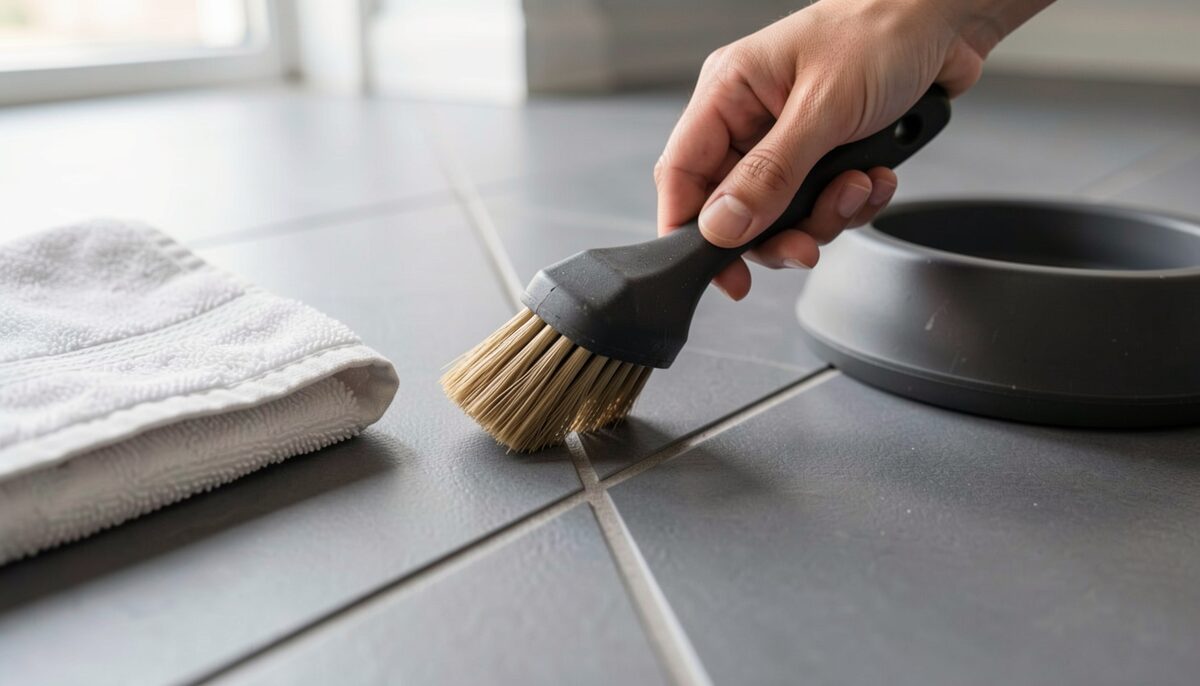
Grout is the weak point of any tiled floor. A cement joint is porous and darkens with muddy water, so people choose a narrow joint, a sealed cement grout or an epoxy grout, which is waterproof and keeps its colour. A wide joint holds dirt and gives nails something to catch; a narrow one wipes clean with a mop. Ask for a mid-grey or warm sand tone, because a white joint never recovers from a season of pond water.
Is a smooth tile safe for a dog that skids?
Not if it is polished. A wet paw on a glossy tile is a sliding paw, and a young dog skidding on a turn can strain a shoulder or a hip. Choose a matt or lightly textured surface and test it with a wet hand: if it feels like glass, the dog will feel it too. Tilers use slip-resistance classes for this, and the higher classes grip better but trap more dirt in the texture, so the sensible middle is a fine grain that a stiff brush still cleans. Read the same caution into the page on what a hip score certifies: a certificate describes the joint, and the floor decides how often that joint is asked to take an awkward landing.
Old dogs and puppies ask for the same thing in different words. A senior golden with stiff hips wants a grippy surface and a rug at the door. A puppy in training wants a floor that forgives accidents and is quick to disinfect. Both are better served by one tiled area than by a house of half-measures.
What should the room itself look like?
Think of the boot room as a small filter between the field and the house. A tiled floor with a slight fall toward the exterior door, or toward a floor drain, sends the water where you want it. A bench with hooks above it keeps coats and leads off the ground. A low shelf holds the towels and the dummy bag, and a washable wall paint or a tiled skirting about thirty centimetres high protects the base of the wall from the shake. If the room has underfloor heating, say so before the work starts, because the adhesive and the joints have to be chosen for it and a cold tiled floor is the single complaint older dogs make about the arrangement.
Leave a dry spot. A raised bed or a folded blanket on a mat at one corner gives the dog somewhere to stand while it dries, and keeps the habit of waiting at the door, the same habit the trial line asks for in steadiness at the line. A dog that has a place to stand will usually take it.
How do you prepare the floor underneath?
Most failures happen under the tile. A floor that is not flat produces hollow tiles that crack when a heavy dog lands on them, and a damp slab produces tiles that lift. So the sequence is the same in any house: measure the flatness, check the moisture, repair cracks, level where needed, then set the tile with the right adhesive and leave the joints time to cure before the first wet dog walks across them. This is why a quote from photos is only a first step, and why a serious tiler comes to look at the substrate on a larger job. Plan the work for a week when the dog can be somewhere else, and keep it off the floor for the full curing time given on the adhesive and grout packaging.
What does a tiled boot room cost to keep?
Very little. A daily wipe with a squeegee or a mop, a stiff brush for the joints once a month, and a mild cleaner without strong bleach is the whole routine. Avoid acid cleaners on cement grout, which dissolve it over time. Wash the mat and the towels weekly, and rinse the door threshold, since it takes most of the abuse. Over a decade, a floor like this outlasts three or four rounds of carpet or vinyl in the same corner, and it makes the condition of the dog easy to read: wet pad prints on pale tile show a limp or a split nail faster than any carpet will.
That last point connects to the litter diary: the first six weeks shows how a breeder reads a pup from small dated observations, and a clean, plain floor is simply where those observations are easiest to make. A tiled, washable area also suits the whelping and rearing space, where hygiene decides more than looks.
Is it worth tiling just for the dog?
If the dog works, yes. A retriever that swims every week deposits more water indoors in a year than most households see from a leaking roof, and a floor that refuses it will last as long as the house. If the dog is mostly a companion and walks on dry paths, a good mat and a washable runner are enough. The question is not taste but how many wet mornings the dog has in a season, and the honest answer is on the floor already, in the grey line along the skirting where the water has been sitting.


